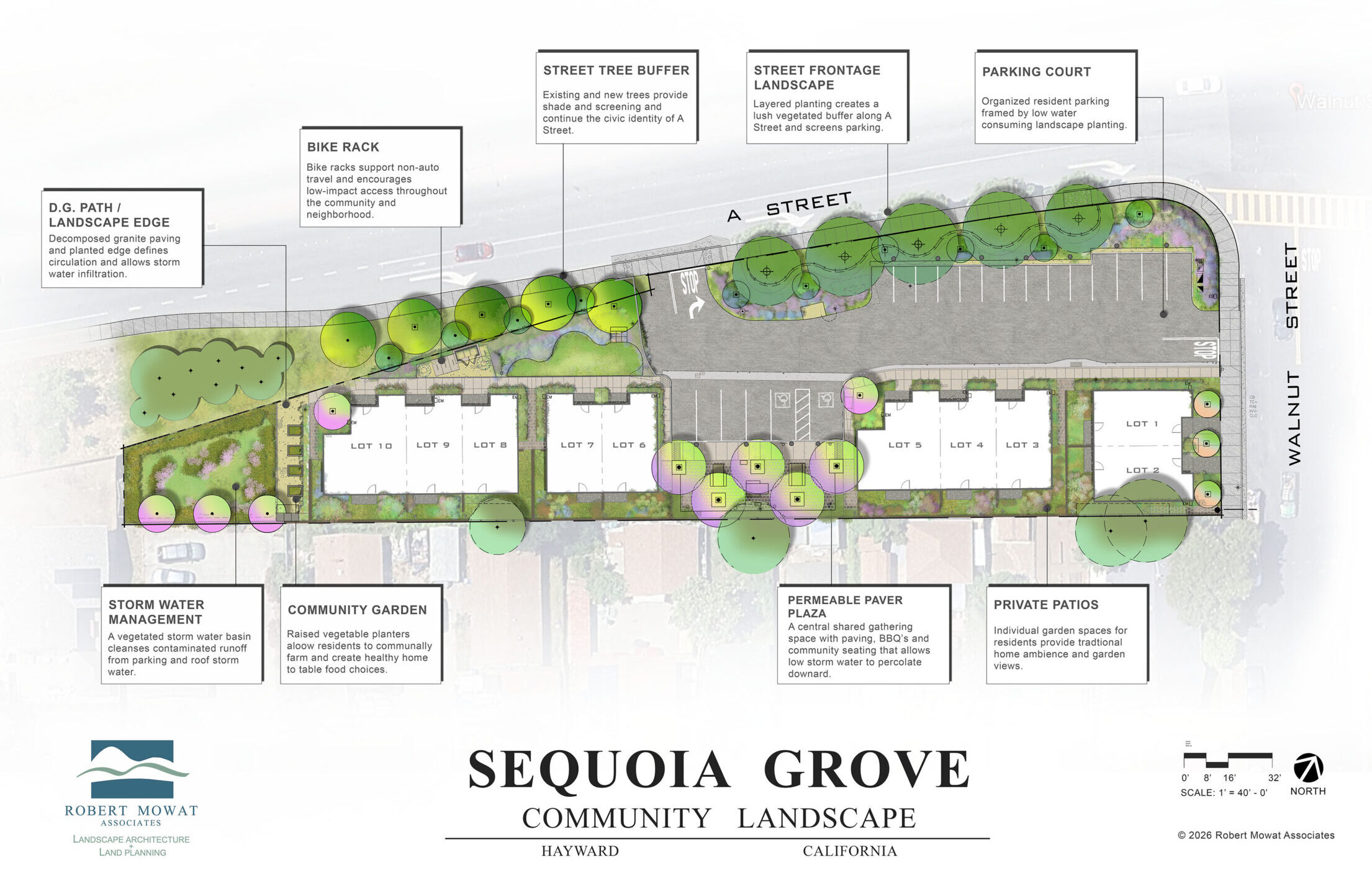
 Sequoia Grove approaches affordable housing landscape as a compact but high-performing community system. On a narrow urban infill site, RMA’s design focuses on making limited outdoor space work harder to creating privacy, shade, neighborhood identity, and shared social spaces within a constrained residential setting.
The design strategy balances individual comfort with community connection. Private patios give residents personal outdoor space, while shared gardens, pedestrian paths, bike access, and small gathering areas create opportunities for everyday interaction. Planting buffers and street trees soften the relationship between homes, parking, and the public street, helping the community feel more settled, shaded, and residential rather than dominated by buildings.
Environmental performance is integrated into the landscape rather than treated as a separate requirement. Storm water is managed through a vegetated basin, permeable paving, and decomposed granite paths that help slow, filter, and infiltrate runoff from roofs, parking, and paved areas. Low-water and California-adapted planting reduces irrigation demand while providing seasonal texture, habitat value, and visual softness across the site.
Tree preservation was also central to the design approach. Existing protected trees, including mature Coast Redwoods, help maintain the site’s established character and provide immediate scale, shade, and ecological value. New planting and mitigation strategies reinforce this framework, allowing the new residential community to fit more naturally into its neighborhood context while improving long-term landscape resilience.
Through layered planting, storm water treatment, shaded edges, protected trees, and flexible social spaces, Sequoia Grove demonstrates how affordable housing landscapes can support both environmental responsibility and everyday community life.